
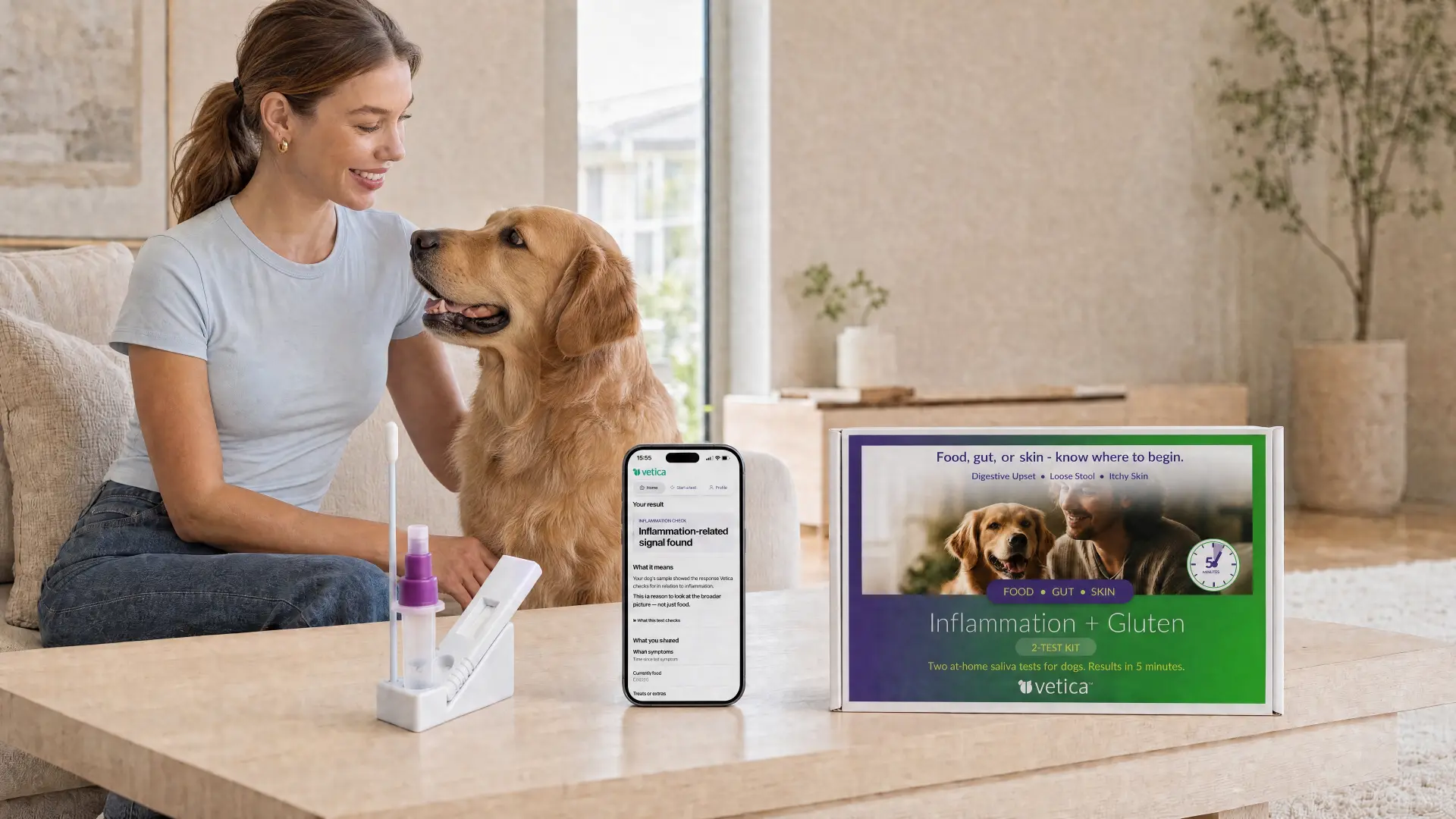
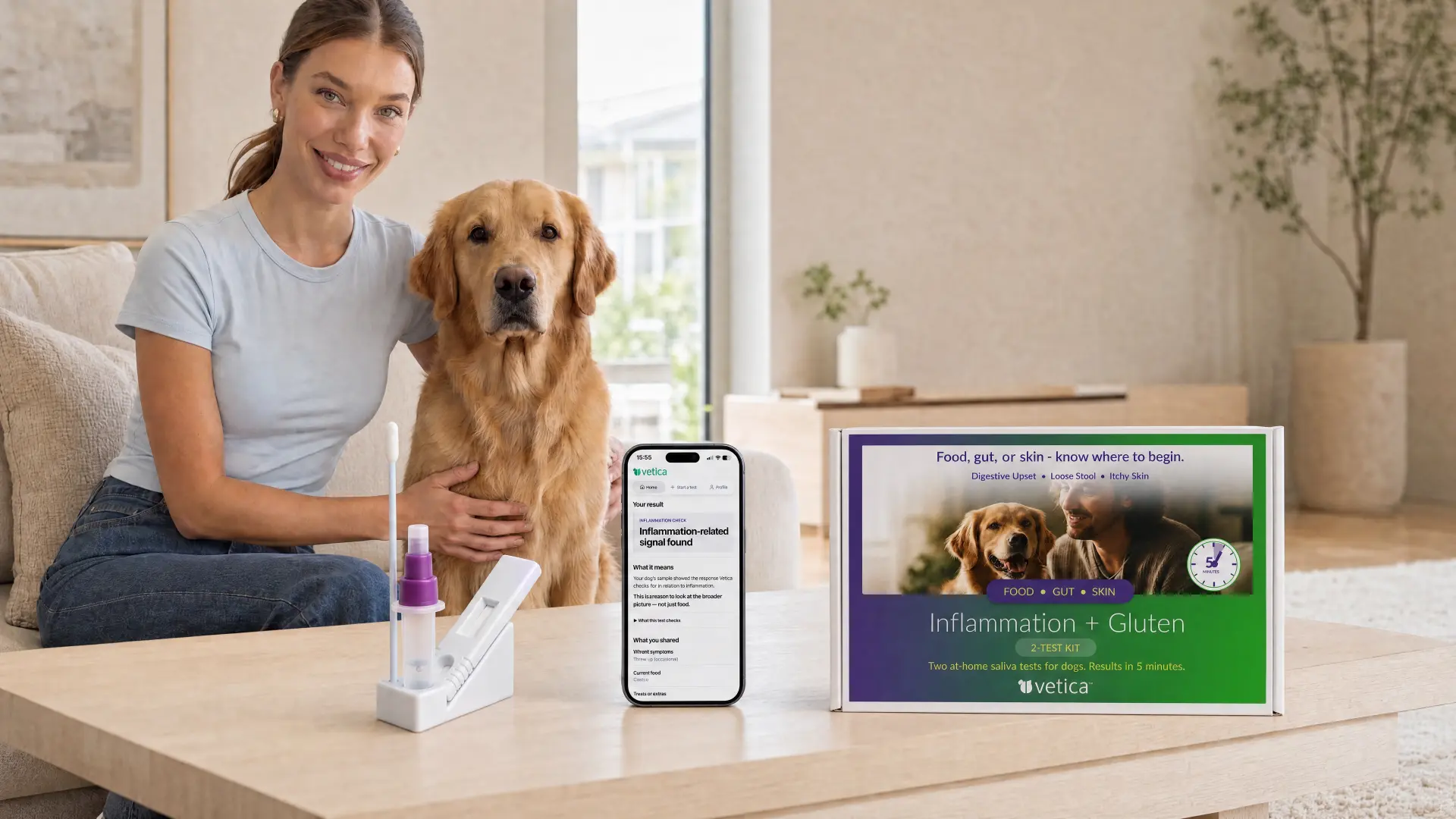
Your dog can’t tell you what’s wrong.
Loose stool, gas, itching — and wondering what’s behind it?
Get a 5-minute at-home check before spending more time and money on trial-and-error.
Swab your dog’s saliva and read the result on the test card in 5 minutes. Save it in the Vetica app.
Choose your test
What do you want to understand about your dog?
Every Vetica test gives you a visible test-card result in 5 minutes. Use the Vetica app to save the result and guide your next steps with a personalized report.
Not sure which test fits?
Answer one quick screen and we’ll point you to a focused place to start.
How it works
A simple at-home check.
Swab, mix, add 3 drops, and read the test card in 5 minutes. Then save the result in the Vetica app.

Collect
Swab saliva from both cheeks.

Mix
Mix the swab in the provided bottle.
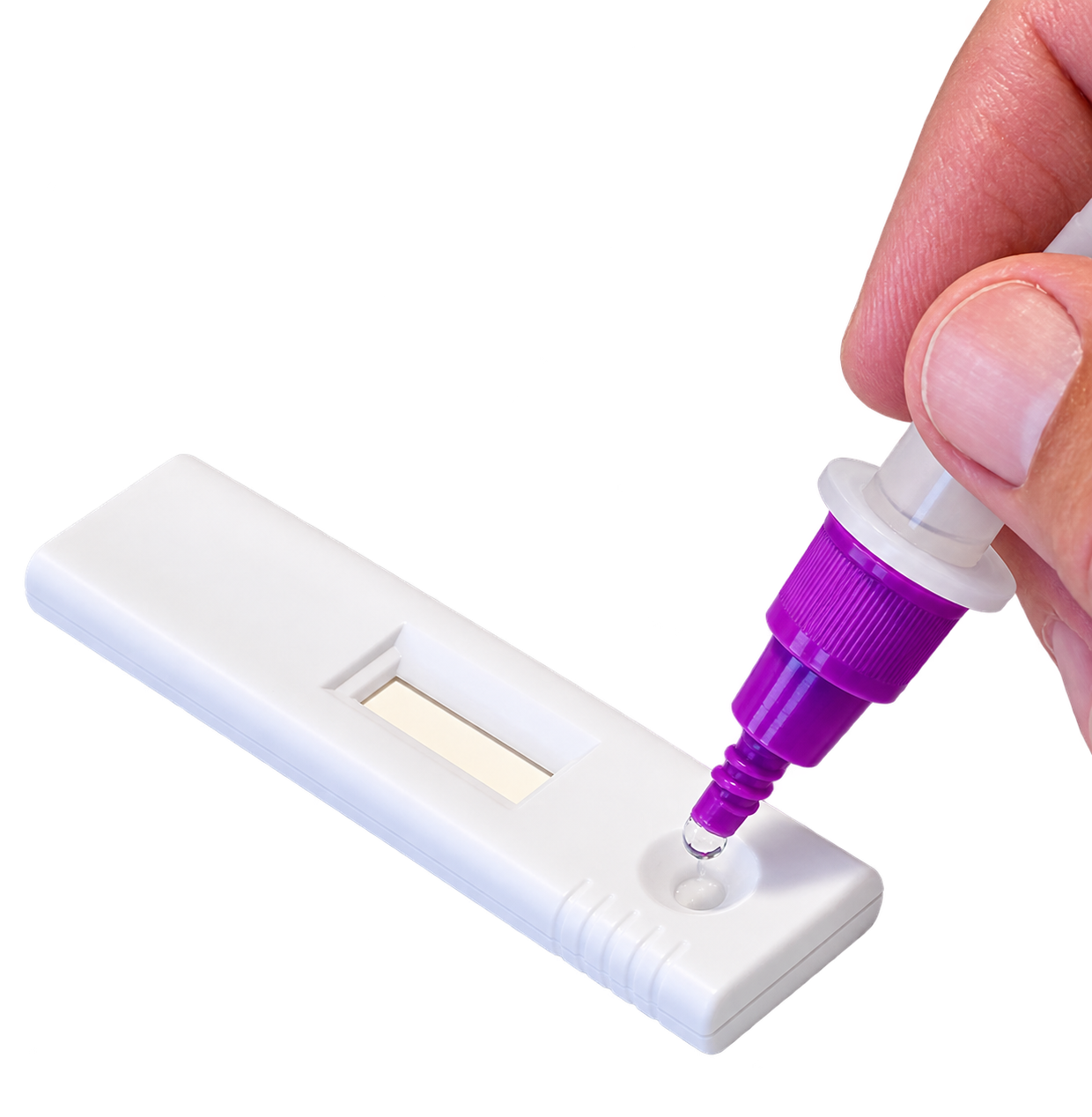
Apply 3 drops
Add exactly 3 drops to the sample well.
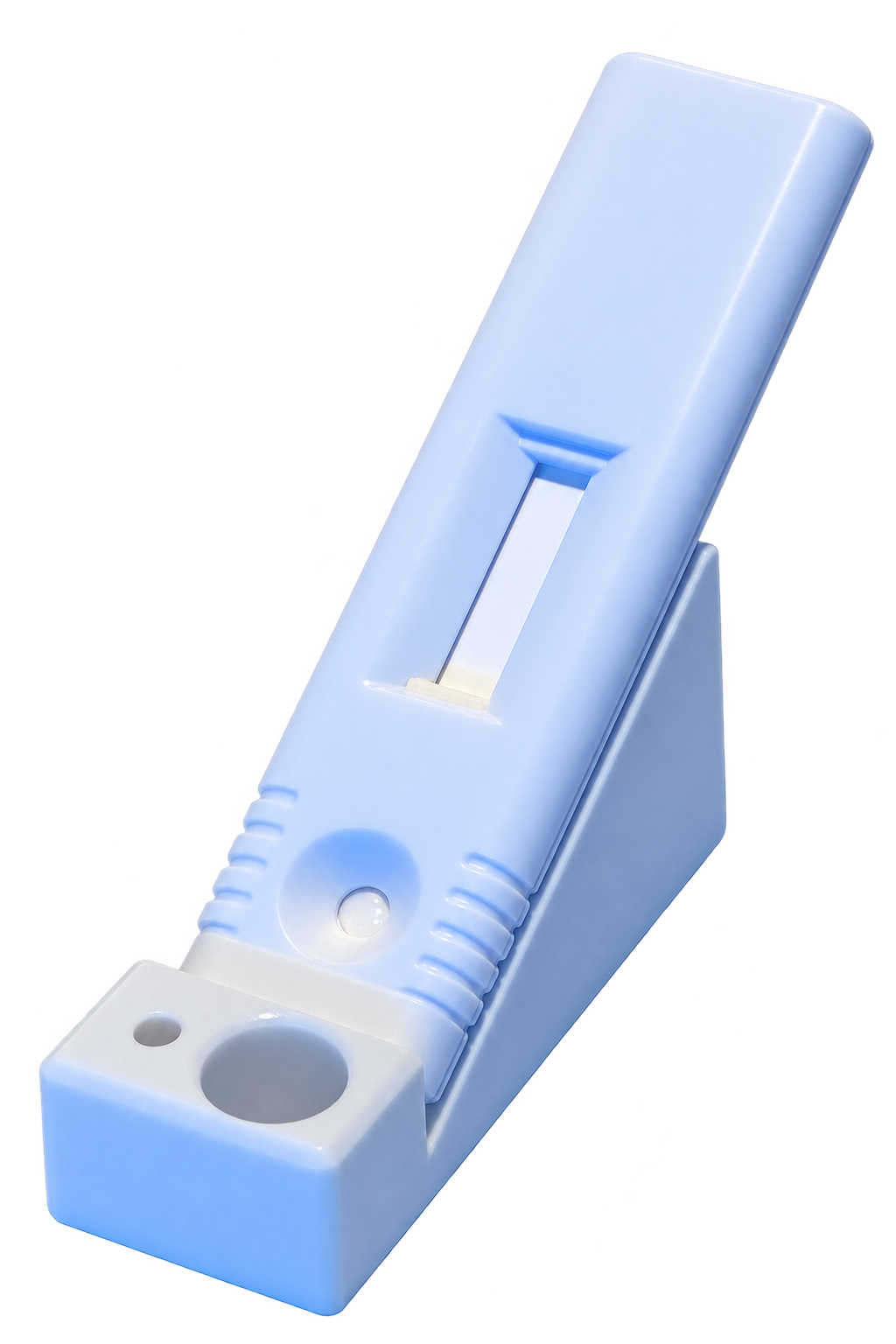
Read in 5 minutes
Read the test card, then scan it in the Vetica app.
Built on established biomarker science
From human medicine to canine research to Vetica.
Calprotectin and gluten-related antibody testing have roots in human medicine and have since been studied in dogs. Vetica builds on that scientific foundation with two rapid saliva tests designed for dogs, then evaluated them in a prospective canine field study.
- 1
Human medicine
Calprotectin and gluten-related antibody testing establish the biological foundation.
- 2
Canine research
Calprotectin has been measured in dog saliva, and gluten-related antibodies have been studied in dogs.
- 3
Vetica saliva tests
Two dog-specific saliva checks: inflammation-related response and gluten-related immune response.
- 4
Canine field study
Vetica evaluated the two rapid saliva tests in client-owned dogs.
Vetica draws on this scientific lineage while measuring defined salivary IgA responses in dogs.
Wondering about any of these?
Choose a question to see the answer.
A food sensitivity is one possibility, but recurring digestive or skin problems can have more than one explanation. Vetica gives you two focused things you can check at home: whether there is a signal related to inflammation and whether your dog is showing an immune response to gluten. Put the result together with symptoms, food, treats, and history to decide what to look at next.
Food allergy vs. sensitivityChanging foods often changes several ingredients at once, so after a few switches it can be hard to know what actually helped. Before trying another, Vetica can check for a signal related to inflammation, an immune response to gluten, or both. Use the result with your dog’s symptoms, current food, treats, and history to make the next food change more deliberate — then watch what gets better, stays the same, or comes back.
How testing fits with food trialsIt means the test found the inflammation-related response Vetica checks for in this saliva sample. Look at it alongside your dog’s symptoms and history. If the signal is found, inflammation is something to pay closer attention to; the next step may be to keep watching, review diet or recent changes, or look more closely at symptoms that keep coming back.
What Inflammation Check measuresA negative result means the response this test checks for was not found in this saliva sample. That is still useful information. Use it with your dog’s symptoms and history. If symptoms keep coming back, persist, or get worse, keep looking at other possible explanations.
See the scienceYou’re paying for an actual saliva-test result, not just advice based on symptoms. Vetica gives you a visible cassette result in 5 minutes, and the app can save that result and put it together with the symptoms, food, treats, and history you provide. That gives you a clearer record to use before more trial-and-error. Your first test and report are useful on their own; repeat testing is optional.
See an example report (PDF) (opens in a new tab)The two tests answer different questions. Inflammation Check looks for a signal related to inflammation. Gluten Response checks whether your dog is showing an immune response to gluten and can be especially useful when digestive symptoms, itching, or recurring skin problems make diet worth a closer look. The 2-Test Kit gives you both cassette results in 5 minutes. If you already know which question you want to answer, starting with one test is reasonable.
Compare the three optionsNot automatically. First look at gluten across the whole diet — main food, treats, chews, table food, and other extras. If gluten is only coming from treats, the main food may not need to change. If the main food also contains gluten, changing only the treats would not remove that exposure. If you decide to try a gluten-focused food change, keep the rest of the routine as consistent as practical and watch what happens to symptoms over time.
What Gluten Response measuresYour first test gives you a result to start from. If you later make a planned food or other relevant change, another Vetica test gives you a second result to compare with the first. Look at both results together with symptoms, food, and whether you were able to stick with the plan. Repeat testing is most useful when you have a specific change or question you want to follow.
See a one-time report (PDF) (opens in a new tab)No. Vetica is not a broad dog food allergy or food sensitivity panel. It gives you focused results for inflammation and gluten to use alongside symptoms, food, and history.
Food allergy vs. sensitivitySome symptoms shouldn’t wait. If your dog is worsening or has concerning symptoms, contact your veterinarian.
A focused first picture
How Vetica compares
1.What am I actually learning?
Vetica
Whether the test finds an inflammation-related signal, an immune response to gluten, or both.
Side by side
- Broad sensitivity panel
- Which foods the panel says may be possible triggers.
- Hair / bioresonance report
- A list of foods and environmental items the report says may be a problem.
- Controlled food trial
- Whether your dog’s symptoms improve when a defined diet is followed and whether they return with reintroduction or challenge.
- Food trial + Vetica
- A Vetica result to start with, plus what happens to your dog’s symptoms when the diet changes.
2.If several things show up, can I tell what matters?
Vetica
Vetica gives you two focused results instead of a long food list. One test checks for a signal related to inflammation; the other checks whether your dog is showing an immune response to gluten.
Side by side
- Broad sensitivity panel
- Not necessarily. Flagged ingredients can overlap across foods, treats, chews, and extras, making them hard to change separately.
- Hair / bioresonance report
- Not necessarily. You still have to decide which reported items are worth acting on.
- Controlled food trial
- A controlled diet reduces variables so you can observe whether symptoms change when the diet changes.
- Food trial + Vetica
- Vetica can help you decide what to focus on before the trial; the food trial then shows what actually happens when the diet changes.
3.Does it tell me where to start?
Vetica
Yes. If the inflammation result is found, inflammation becomes worth a closer look. If the gluten response is found, review where gluten shows up across the diet.
Side by side
- Broad sensitivity panel
- It gives you a list, but you still have to decide which food to investigate first.
- Hair / bioresonance report
- It gives you a list, but you still have to decide which item to act on first.
- Controlled food trial
- It gives you a structured way to see whether food may be contributing to symptoms, but it does not give you a test result before you start.
- Food trial + Vetica
- Start with the Vetica result, then use a controlled food trial to see what happens when the diet changes.
4.How does this help me learn what actually matters over time?
Vetica
Use the first result as a starting point. If you repeat the test later, compare the results with what happened to symptoms and what changed in the diet.
Side by side
- Broad sensitivity panel
- You still have to work through the listed foods and see which ones actually matter.
- Hair / bioresonance report
- You still have to act on the reported items and see what changes.
- Controlled food trial
- Track whether symptoms get better, stay the same, or return during the diet and, when appropriate, after reintroduction or challenge.
- Food trial + Vetica
- Start with the Vetica result and symptoms, record the food plan and any diet slips, then watch what gets better, stays the same, comes back, or gets worse. A follow-up Vetica test can add another result to compare.
5.How quickly do I get useful information?
Vetica
First result at home in 5 minutes. No sample mailing.
Side by side
- Broad sensitivity panel
- Turnaround varies, then flagged foods still need to be worked through in the diet.
- Hair / bioresonance report
- Turnaround varies, then reported items still need real-world follow-up.
- Controlled food trial
- A food trial usually takes weeks, and food-allergy confirmation requires an appropriate elimination-and-challenge process.
- Food trial + Vetica
- The Vetica result is available at home in 5 minutes; the food trial itself still takes weeks.
The practical difference
Broad sensitivity panels can flag several possible foods, but those ingredients often overlap across commercial diets, treats, chews, and extras. That can make it difficult to know which finding actually matters or what to change first.
Vetica starts with a real test result. Inflammation Check looks for a signal related to inflammation. Gluten Response checks whether your dog is showing an immune response to gluten. Use the result with symptoms, food, treats, and history to decide what to look at next.
A controlled food trial shows what happens when the diet changes. Food trial + Vetica brings the two together.
From result to next step
Put the result to work.
Your test card gives you the result. The Vetica app helps you save it and put it next to symptoms, food, treats, and history. Then you can decide what to watch, change, or look at more closely — and see what happens after a change.
- 01
Vetica result
What the test card found in 5 minutes.
- 02
Symptoms + history
What you are seeing and when it happens.
- 03
What you do next
Keep watching, review diet, or look more closely.
- 04
What happens over time
What gets better, stays the same, comes back, or gets worse.
Food trial + Vetica
Vetica and a controlled food trial answer different questions. Vetica gives you a test result at the start; the food trial shows what happens when the diet changes. Record the food plan, treats and extras, and any diet slips, then watch what happens to symptoms over time.
For a gluten-focused trial, look across the whole diet — main food, treats, chews, table food, supplements, and flavored products — so the gluten exposure you are testing is actually controlled.
If useful, a follow-up Vetica test gives you another result to compare with the first.
A controlled elimination diet with challenge or reintroduction remains the reference approach for confirming food allergy. Vetica is designed to complement that process, not replace it.
Some symptoms shouldn’t wait. If your dog is worsening or has concerning symptoms, contact your veterinarian—don’t wait for a test or finish a food trial first.
Help Me ChooseLearn more
Go deeper when you need to.
Sensitive stomach
Recurring digestive symptoms and what to notice.
Learn moreFood allergy vs sensitivity
Understand the terms and where testing fits.
Learn moreLoose or frequent stool
Patterns that can help guide the next step.
Learn moreItching and skin
Why food may be one part of a wider picture.
Learn moreGet clarity. Know your next step.
Start with a 5-minute result for inflammation, gluten, or both — then use the app to put it together with what you are seeing at home.